Wedding of Camacho the Rich
Don QuixoteThe Wedding of Camacho the Rich turns a lavish marriage celebration into a contest over love, wealth, consent, and appearances. Basilio, whose longstanding love for Quiteria has been thwarted by her father’s preference for a richer match, stages a crisis at the ceremony that makes her marriage to him possible. His apparent death proves to be a trick; the wedding, however, is confirmed freely by Quiteria, and Don Quixote defends the couple when Camacho’s supporters react with violence.
Background and the Match
The episode begins with Don Quixote and Sancho Panza on the road after leaving Don Diego’s village. They meet two students and two peasants, who tell them about a wedding celebrated on a scale that has made it famous in the surrounding country. The bride, Quiteria, is eighteen; the bridegroom, Camacho, is twenty-two and reputed to be the richest man in the district. Their social positions appear well matched to the guests, though some observers consider Quiteria’s family better connected by ancestry. The account makes the tension between family standing and money part of the wedding’s setting: Camacho’s wealth is substantial enough, it is said, to repair perceived disadvantages of birth.
Basilio’s claim on Quiteria predates the planned marriage. He grew up next door to her family, and the two loved each other from childhood; their affection was familiar talk in the village. Quiteria’s father eventually restricted Basilio’s access to the household and arranged her marriage to Camacho, judging Basilio’s prospects too modest. Yet Basilio is not presented as lacking gifts: he is celebrated locally for his athletic skill, strength, running, jumping, bowling, singing, guitar playing, and swordsmanship. The contrast is between a young man rich in natural ability and a bridegroom whose wealth helps secure the match.
The Wedding and Basilio’s Apparent Death
The wedding party approaches amid music, mounted attendants, relatives, and guests from neighboring villages. A decorated theatre has been set up beside the meadow for the couple’s vows and the festivities. Sancho admires Quiteria’s fine clothing and jewelry, while Don Quixote considers her exceptionally beautiful, setting aside only his idealized lady, Dulcinea del Toboso. The public ceremony thus begins amid display and anticipation, with the couple about to proceed to the place prepared for their vows.
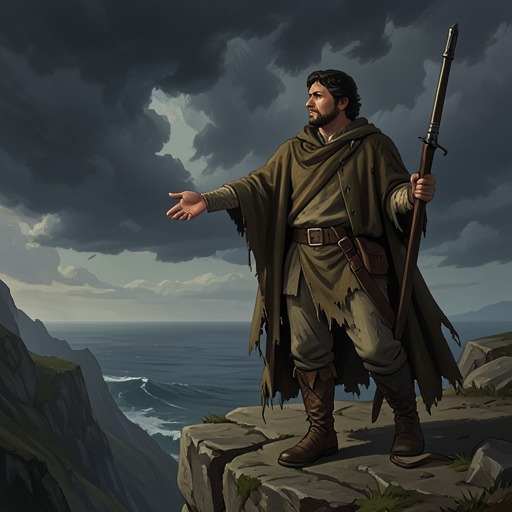
Basilio abruptly interrupts. Dressed in black with crimson patches, crowned with cypress, and carrying a staff, he steps before the bride and bridegroom. He presents himself as a rejected lover whose poverty has cost him his happiness, then turns the staff into an apparent weapon and stages his own death. His friends rush to help. Don Quixote dismounts from Rocinante and supports the wounded-looking Basilio, while those present fear that he may die before the priest can hear his confession.
Basilio makes his recovery conditional on Quiteria giving him her hand in marriage. The priest urges him to attend to his soul, but Basilio refuses to confess until Quiteria answers him. Don Quixote argues that the request is reasonable and that Camacho would lose little by allowing Quiteria to marry Basilio at the last moment. Camacho is bewildered, then yields to the pressure of Basilio’s friends, provided Quiteria herself agrees. The gathered company presses her to respond, and the priest demands a decision while Basilio appears close to death.
Quiteria approaches and takes Basilio’s hand. At his insistence that she not act merely from pity or to deceive him, she declares that she gives it freely and accepts his in return, whether he lives or dies. Basilio likewise affirms the marriage of his own free will. The priest blesses them. Immediately afterward, Basilio rises and exposes the deception: the apparent wound was produced with a hollow iron tube, and the apparent blood had been prepared for the trick. The priest and many of the guests realize they have been fooled. When some argue that the marriage cannot stand because it was obtained by fraud, Quiteria confirms it again.
The Clash and Its Resolution
The disclosure changes the wedding from a scene of apparent bereavement into an open dispute. Camacho’s supporters draw their swords against Basilio, and an opposing group arms itself in his defense. Don Quixote takes the lead on horseback, shield raised and lance ready, and makes the crowd give way. Sancho, who has little appetite for armed confrontation, withdraws toward the wine jars rather than join the struggle.
Don Quixote’s intervention rests on his view that love permits stratagems, provided they do not dishonor the beloved. He declares that Quiteria and Basilio belong together and argues that Camacho, as a rich man, can find other pleasures, whereas Basilio has only this love. His defense turns the dispute into a test of whether wealth and social advantage can override the couple’s declared choice. The priest’s counsel also helps calm Camacho and his followers. Camacho accepts that Quiteria has chosen Basilio and directs that the festival continue, presenting his conduct as proof that he bears no resentment.
The newly married couple and their companions do not remain for Camacho’s feast. They leave for Basilio’s village, accompanied by Don Quixote, whom they regard as a worthy and courageous defender. Their departure leaves the wedding divided: Camacho’s celebration continues, but the bride and the bridegroom are gone. Sancho follows Don Quixote on Dapple, disappointed to miss the abundant food and festivities. His attention to the feast he has lost provides a comic counterpoint to the high-minded dispute over love and marriage.
Significance
The episode repeatedly contrasts outward appearance with underlying fact. Basilio seems to have died, but the scene is a deliberate construction; Camacho appears to possess the advantage of wealth and a public wedding, but Quiteria’s decision overturns the expected outcome. Even the apparent emergency does not finally settle the marriage: the couple affirm their choice, and Quiteria confirms it again after the trick is discovered. The revelation exposes the method without undoing the result.
The story also places consent and status in tension. Quiteria’s father had arranged the match with Camacho because Basilio was poorer, but at the ceremony Quiteria speaks for herself and accepts Basilio as her lawful husband. Don Quixote supports that choice through the language of love and knightly justice, while the priest’s presence makes the exchange a formal marriage rather than merely a romantic escape. The conflict resolves not through Camacho’s wealth prevailing, but through his withdrawal and the couple’s departure together.
The episode’s comic reversals do not erase the danger of the staged scene or the ensuing armed confrontation; instead, they redirect both toward a resolution without a lasting fight. Basilio’s trick briefly turns a wedding into what looks like a funeral, then transforms the apparent death into an unexpected marriage. Don Quixote’s defense gives the reversal its public force, while Sancho’s concern for the feast keeps the scene grounded in practical appetite. The result is a wedding whose spectacle belongs to Camacho, but whose final choice belongs to Quiteria and Basilio.